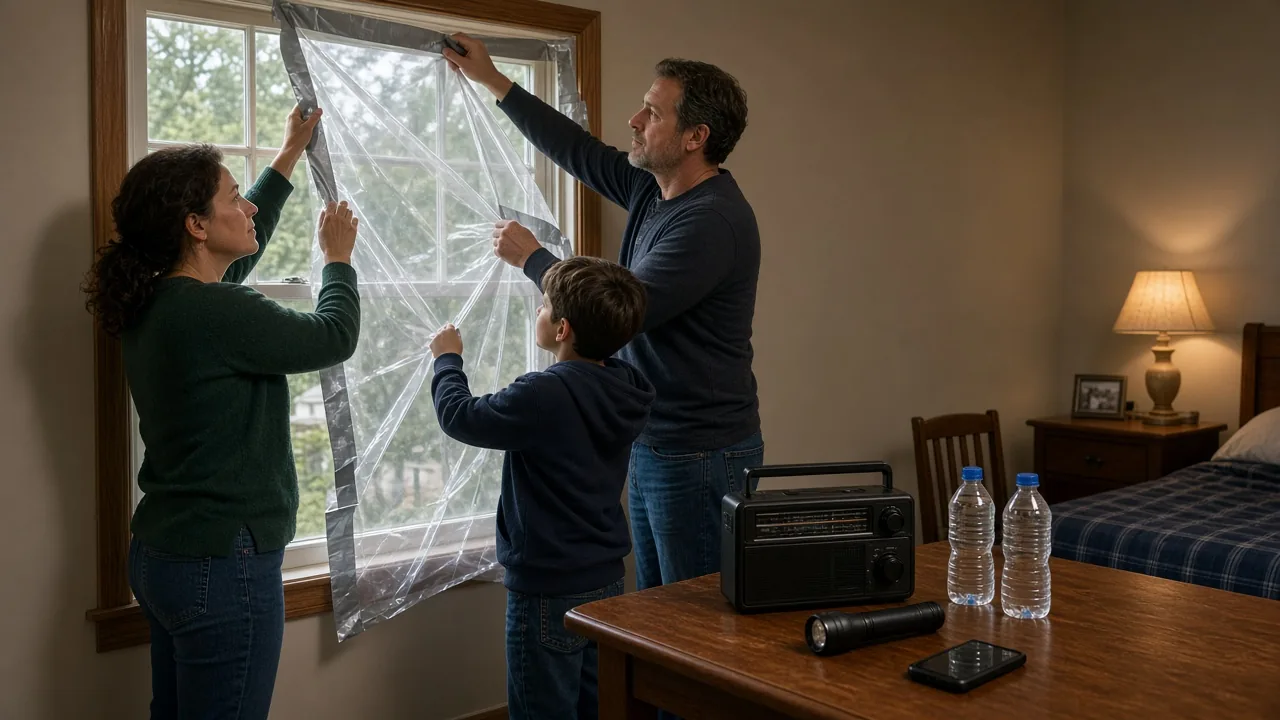
Thanksgiving Storms and Power Outages: How to Prepare and Keep Your Family Safe
Thanksgiving is supposed to be about family, food, and football. This year, for millions of Americans, it's also about wind, rain, snow, and the real chance that the lights go out halfway through cooking the turkey. Here's what forecasters are warning about this week, and how to keep your family warm, fed, and safe if a storm knocks out your power over the holiday.
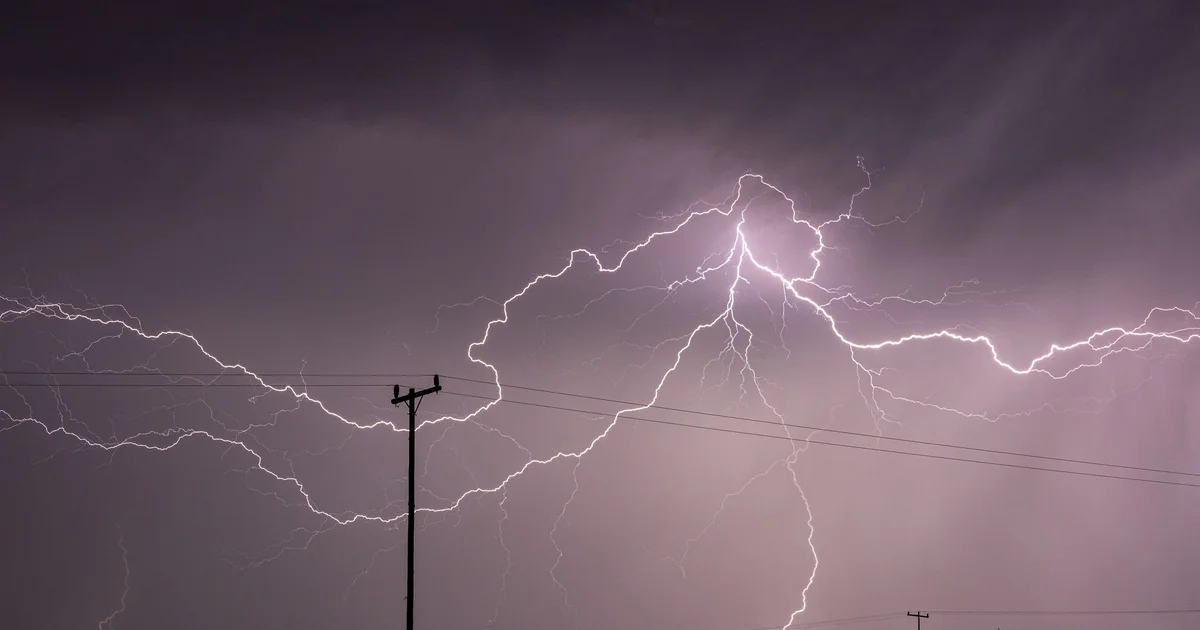
What's Happening This Thanksgiving Week (Nov. 25, 2026)
According to NOAA's Thanksgiving week forecast, published November 24, a powerful coastal storm will lash the eastern half of the country while a Pacific system brings rain and mountain snow to the West. NOAA's Weather Prediction Center expects heavy rain, high winds, and flooding from the Ohio Valley to the Eastern Seaboard on Thanksgiving Day, with strong winds and coastal flooding likely to affect morning travel, Turkey Trots, and parades from the Carolinas to southern New England. Heavy rain is expected to linger into Friday for much of New England.
FOX Weather's live coverage on Wednesday, November 25, says the storms are targeting more than 250 million people. Its key points:
- Wind gusts could reach 70 mph along the coast, with 40 to 60 mph gusts inland.
- High Wind Watches are in place across Maryland, New Jersey, eastern Pennsylvania, New York City, Long Island, and Philadelphia.
- That combination raises the threat of widespread power outages across the Mid-Atlantic and Northeast.
- Pacific storms and potentially record-breaking coastal flooding threaten California, with San Francisco in the bull's-eye Wednesday.
In the Midwest, the National Weather Service in St. Louis has a Winter Storm Warning in effect from noon Wednesday to 6 p.m. Thursday for the St. Louis metro and surrounding areas. It forecasts 3 to 9 inches of snow, with more than a foot possible in a narrow band. Because many trees still have their leaves, the heavy, wet snow could bring down branches and power lines, causing sporadic outages.
Why This Winter Could Be Hard on the Grid
On November 19, 2026, federal regulators released their Winter Energy Market and Electric Reliability Assessment. The FERC staff report says NOAA forecasts a very strong El Niño this winter, which usually means milder overall temperatures, but also an increased risk of polar vortex disruptions that can bring extreme cold to the central and eastern U.S. Under extreme weather, it flags elevated risks for SERC-East (parts of the Southeast), New England (where stored fuel could run down in a long cold snap), and import-dependent pockets of MISO and SPP in the central U.S. The North American Electric Reliability Corporation warned that rising demand and El Niño will challenge grid operators this winter.
In other words: this week's storms are a good reason to get your outage plan in shape for the whole winter, not just the holiday.
Your Pre-Storm Checklist (Do This Today)
Ready.gov and the American Red Cross both recommend preparing before the power goes out. If you're in the storm's path, use Wednesday to:
- Charge every phone, tablet, and power bank, and keep a car charger handy.
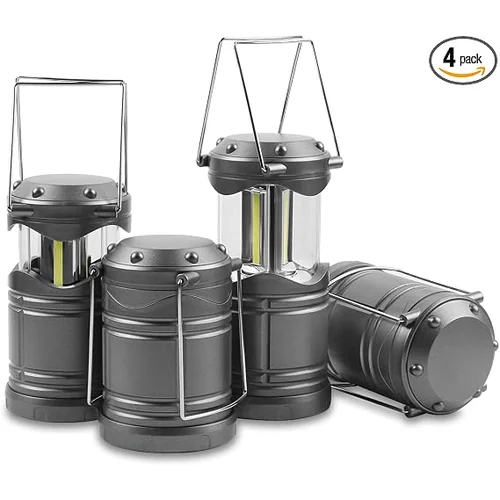
- Put fresh batteries in flashlights and lanterns. Have one light per person, and skip candles if you can.
- Test smoke and carbon monoxide alarms and make sure they have battery backup.
- Fill your car's gas tank. Gas pumps need electricity to work.
- Get some cash in small bills in case card readers are down.
- Fill pitchers and jugs with drinking water, especially if you're on a well.
- Set your fridge and freezer to their coldest settings and add frozen water bottles or ice packs to fill empty space.
- Plan ahead for medicines that need refrigeration and medical devices that need power.
- Bring in or tie down patio furniture, decorations, and anything wind could throw.
- Know where your nearest warming center is, and sign up for local alerts.
Our home power outage kit checklist and 72-hour emergency kit guide cover the full supply list.
Keep the Thanksgiving Meal Safe in an Outage
A full fridge of Thanksgiving food is a lot to lose. The good news: if you know the time limits, you can save most of it.
Fridge and Freezer Time Limits
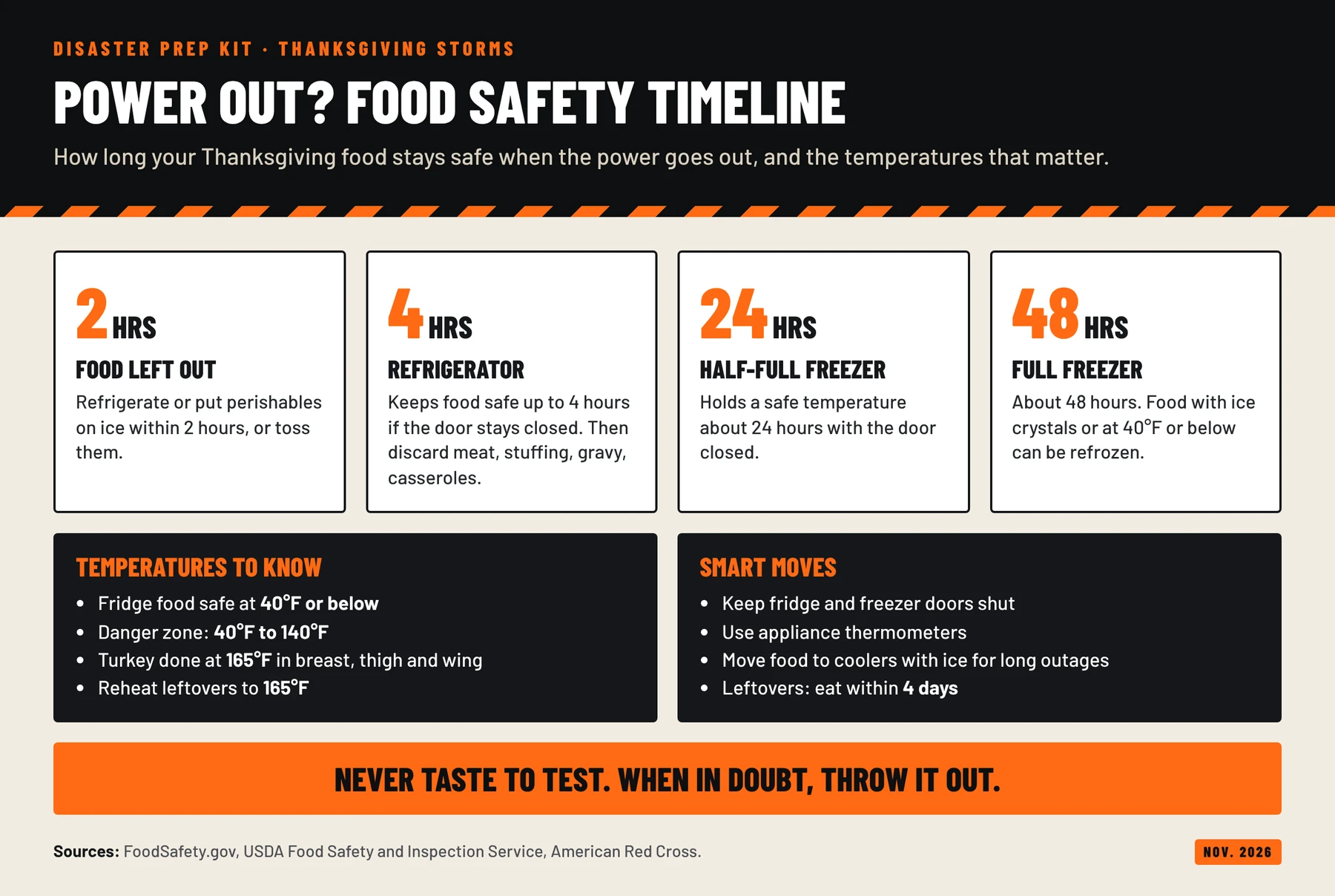
FoodSafety.gov says a refrigerator will keep food safe for up to 4 hours during an outage if you keep the door closed. A full freezer holds a safe temperature for about 48 hours, or 24 hours if it's half full and the door stays closed. After 4 hours without power, throw out refrigerated perishables such as meat, poultry, stuffing, gravy, casseroles, and leftovers. Never taste food to decide if it's safe. When in doubt, throw it out.
A few tips that help:
- Keep an appliance thermometer in the fridge and freezer. Food at 40°F or below is safe.
- If the outage will run long, move food into coolers packed with ice or snow-filled bags. A cold garage or porch is not a reliable fridge, because sun and swings in temperature can warm food fast.
- Food that still has ice crystals or is at 40°F or below can be refrozen, though quality may suffer.
Turkey and Leftovers
The USDA's Food Safety and Inspection Service says turkey must reach 165°F, checked with a food thermometer in the thickest part of the breast, the innermost part of the thigh, and the innermost part of the wing. If the power goes out mid-roast, don't leave a partly cooked bird sitting at room temperature and finish it later. Either finish cooking it safely right away by another method, or throw it out.
Follow the two-hour rule: refrigerate (or pack on ice) all perishable food within two hours. Leftovers are good for up to four days in the fridge, and should be reheated to 165°F.
Cooking Without Power, Safely
Many families will be tempted to fire up the grill or a camp stove in the garage. Don't. The CDC says carbon monoxide is an odorless, colorless gas that kills without warning. More than 400 Americans die each year from unintentional CO poisoning not linked to fires, more than 100,000 visit an emergency department, and more than 14,000 are hospitalized.
- Never use a charcoal grill, camp stove, or generator indoors, in a garage, or on a covered porch.
- Never heat your home with a gas oven or stove.
- Cook outdoors only, well away from doors and windows.
- Know the symptoms: headache, dizziness, weakness, upset stomach, vomiting, chest pain, and confusion. If your CO alarm sounds or someone feels sick, get everyone outside and call 911.
If you have a gas stovetop that still lights with a match, you can cook on it with good ventilation, but never use it for heat.
Generator Safety
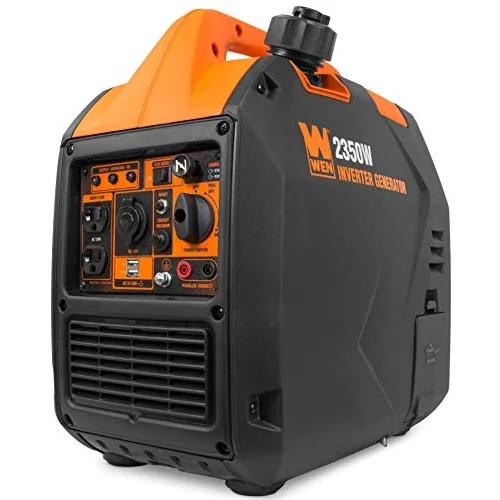
A portable generator can save your food and keep a space heater or medical device running, but it's also one of the leading causes of CO deaths after storms. The CDC says to:
- Run it only outdoors, more than 20 feet from windows, doors, and vents.
- Never run it in a garage, basement, or shed, even with the door open.
- Use a battery-powered or battery-backup CO detector in your home while it runs.
Never plug a generator into a wall outlet ("backfeeding"). It can electrocute utility workers and neighbors. Use heavy-duty outdoor extension cords, or have an electrician install a transfer switch. For quieter options, see our guide to modern backup power for emergencies.
Staying Warm When the Heat Goes Out
Ready.gov's winter weather guidance notes that winter storms raise the risk of hypothermia, frostbite, CO poisoning, and heart attacks from overexertion. To hold heat:
- Gather everyone in one room, ideally with few windows, and close off the rest of the house.
- Dress in layers, wear hats and socks, and use sleeping bags and extra blankets.
- Hang blankets over windows and put towels under doors.
- If you use a space heater on backup power, the CDC says to keep it at least 3 feet from anything that can burn and avoid extension cords.
- If your home gets too cold, go to a warming center or a friend's house with power. Older adults, babies, and people with health conditions should move early.
Shoveling heavy, wet snow is hard on the heart. Take breaks and don't push it.
Stay Charged and Get Alerts
Your phone is your lifeline for alerts and for checking on family, so protect the battery:
- Turn on low-power mode, lower screen brightness, and close apps you don't need.
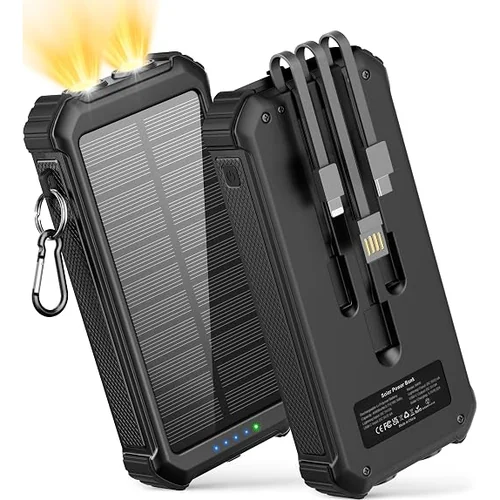
- Charge power banks now, and use your car to recharge (outside, never in a closed garage).
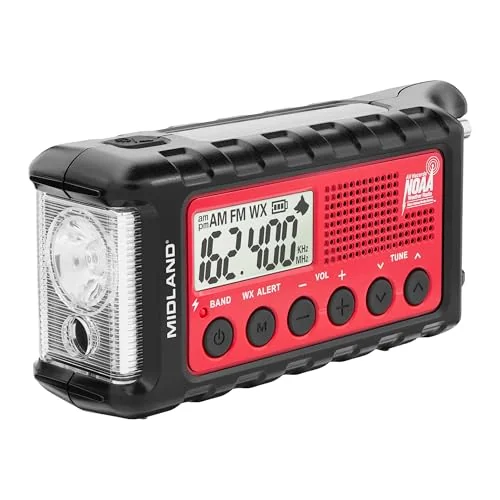
- Keep a battery or hand-crank NOAA weather radio. It works when cell networks are jammed. See our best emergency radios guide.
- Turn on Wireless Emergency Alerts in your phone settings, and sign up for your county's alert system.
- Report your outage to your utility and check its outage map for restoration estimates.
Holiday Travel in Stormy Weather
If you're driving to Thanksgiving dinner, check the forecast for your whole route and be ready to change plans. The NWS St. Louis warning advises people to delay travel if possible during the heaviest snow.
- Leave early or stay put. No dinner is worth driving in a whiteout or through high winds.
- Keep a winter car kit: blankets, water, snacks, a flashlight, a phone charger, jumper cables, and sand or kitty litter. Our winter car survival kit checklist has the full list.
- Tell someone your route and when you expect to arrive.
- Never drive into flooded roads. The National Weather Service says 12 inches of rushing water can carry away most cars, and 2 feet can carry away SUVs and trucks. Turn around, don't drown.
- Watch for downed trees and wires, and treat dark traffic lights as four-way stops.
Check on Elderly Relatives and Neighbors
Older adults are at the highest risk in a winter outage, and many of them live alone. Before the storm, call older family members and neighbors. Make sure they have flashlights, a way to stay warm, enough medicine, and a charged phone. Find out whether they use oxygen or other power-dependent medical devices, and make a plan to get them somewhere with power if the outage drags on. The Red Cross recommends building a support network of people who can help you stay home or leave during a long outage. Keep a paper copy of everyone's phone numbers.
Flooding and Downed Power Lines
- Stay at least 35 feet away from fallen power lines and anything they touch, the Red Cross says. Assume every wire is live, and call 911 and your utility.
- Don't walk or drive through standing water that could hide a live wire.
- Don't use electrical equipment that has been underwater. Have an electrician check it first.
- Keep kids and pets away from fallen trees, which may be tangled with wires.
What to Do When the Power Comes Back
- Check your fridge and freezer thermometers. Throw out perishables that have been above 40°F for more than 2 hours.
- Turn appliances and electronics back on one at a time to avoid a power surge.
- If circuit breakers tripped or anything was flooded, have an electrician inspect before you reset.
- Replace any medicines that needed refrigeration, after checking with your pharmacist.
- Restock flashlights, batteries, water, and fuel, so you're ready for the next storm this winter.
For a bigger-picture plan, read our guide to preparing for a grid-down scenario.
Frequently Asked Questions About Thanksgiving Storms and Power Outages
How long will food stay safe in the fridge if the power goes out on Thanksgiving?
FoodSafety.gov says a refrigerator keeps food safe for up to 4 hours if the door stays closed. After that, throw out perishables such as turkey, stuffing, gravy, and casseroles. A full freezer holds for about 48 hours (24 hours if half full).
What should I do if the power goes out while the turkey is cooking?
Don't leave a partly cooked turkey at room temperature to finish later. Finish cooking it right away by a safe method, such as on a gas stovetop with good ventilation or on an outdoor grill well away from the house, until it reaches 165°F in the breast, thigh, and wing. If you can't, throw it out.
Can I use my grill or camp stove indoors during a power outage?
No. Charcoal grills, camp stoves, and generators produce carbon monoxide, an odorless gas that kills hundreds of Americans each year, according to the CDC. Use them only outdoors and far from windows and doors, and never in a garage.
How far from my house should a generator be?
The CDC says to run portable generators outdoors only, more than 20 feet from windows, doors, and vents, and to use a battery-powered CO detector inside while it runs.
How far should I stay from a downed power line?
The Red Cross recommends staying at least 35 feet from fallen power lines and anything they're touching. Assume the line is live and call 911 and your utility.
Which areas face the biggest storm and outage risk this Thanksgiving?
As of November 25, 2026, FOX Weather says High Wind Watches cover Maryland, New Jersey, eastern Pennsylvania, New York City, Long Island, and Philadelphia, with widespread outages possible in the Mid-Atlantic and Northeast. The NWS has a Winter Storm Warning for the St. Louis area, where heavy, wet snow could bring down trees and power lines.
Sources
- NOAA, Thanksgiving week weather: Potent coastal storms, rain and snow to impact travel (Nov. 24, 2026)
- FOX Weather, Live updates: Thanksgiving storms target 250M+ with intense winds, heavy rain, flooding (Nov. 25, 2026)
- National Weather Service St. Louis, Area Forecast Discussion (Nov. 25, 2026)
- FERC, Winter Energy Market & Electric Reliability Assessment (Nov. 19, 2026, PDF)
- NERC, Increasing Demand and El Niño Challenge Winter Grid Reliability
- FoodSafety.gov, Food Safety During Power Outage
- USDA FSIS, Happy Thanksgiving food safety
- CDC, Carbon Monoxide (CO) Poisoning Basics
- CDC, Safety Guidelines: During and After a Winter Storm
- Ready.gov (FEMA), Power Outages
- Ready.gov (FEMA), Winter Weather
- American Red Cross, Power Outage Safety
- National Weather Service, Turn Around Don't Drown