Bitcoin and USDC Explained: How They Work, Why People Hold Them, and What to Watch Out For
Most preparedness plans start with water, food, and a little cash. But more people are now asking where Bitcoin and USDC fit in, especially after recent bank outages left customers locked out of their accounts for hours. Some see crypto as a way to keep part of their money outside a single bank. Others see a scam magnet. Both views have some truth in them.
This guide explains, in plain language, what Bitcoin and USDC are and how they work, how people buy and store them, why some people hold them, and what to watch out for before you put a dollar in. It's written for families who care about being ready, not for traders.
What Is Bitcoin?
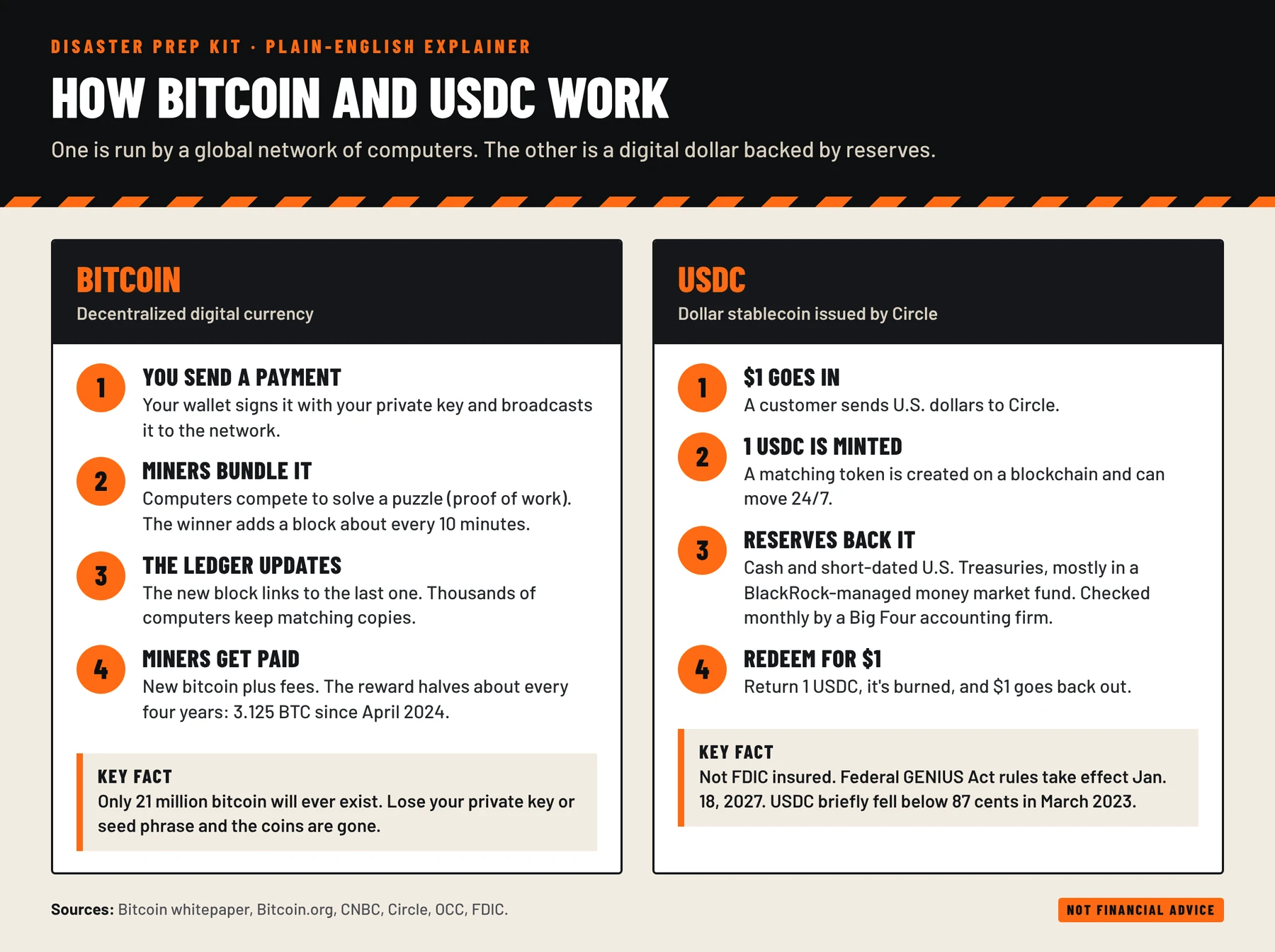
Bitcoin is digital money that no bank or government issues or controls. It was described in a nine-page paper published in 2008 under the name Satoshi Nakamoto, titled Bitcoin: A Peer-to-Peer Electronic Cash System. The goal was to let people send payments "directly from one party to another without going through a financial institution."
Instead of a bank keeping the ledger, thousands of computers around the world each keep a copy. Anyone can download the software and check the rules for themselves.
How the Blockchain Works
The blockchain is that shared ledger. Every Bitcoin payment is broadcast to the network, and payments are grouped into "blocks." Each new block is linked to the one before it, forming a chain that runs back to the very first block in 2009. Changing an old payment would mean redoing the work for that block and every block after it, which is what makes the record so hard to fake.
According to Bitcoin.org, new blocks are added about every 10 minutes on average. Each new block buried on top of your payment makes it harder to reverse.
Mining and Proof of Work
Who adds the blocks? "Miners." They run specialized computers that compete to solve a math puzzle. The first to solve it adds the next block and earns newly created bitcoin plus transaction fees. This is called proof of work. The Bitcoin whitepaper explains that as long as honest computers control most of the computing power, they will keep building the longest chain and stay ahead of attackers.
The network automatically makes the puzzle harder as more miners join, so blocks keep arriving roughly every 10 minutes no matter how much computing power is pointed at it.
The 21 Million Supply Cap
Bitcoin.org says only 21 million bitcoins will ever be created. New coins enter circulation at a decreasing, predictable rate: the reward for each block is cut in half at set intervals, an event called the "halving." The most recent halving, in April 2024, cut the miner reward to 3.125 bitcoins from 6.25, according to CNBC. You don't have to buy a whole coin. Each bitcoin divides into 100 million units called satoshis.
Wallets and Keys
You don't hold bitcoin the way you hold a dollar bill. You hold keys. The SEC's crypto custody bulletin for retail investors explains it simply:
- A public key is like an email address. You share it so people can send you crypto.
- A private key is like the password. It authorizes spending. "If you lose your private key, you permanently lose access to the crypto assets in your wallet."
A "wallet" is just the app or device that stores those keys. There's no "forgot password" link and no customer service line for the Bitcoin network itself.
What Is USDC?
USDC is a stablecoin: a digital token designed to always be worth one U.S. dollar. It's issued by Circle, a U.S. company, and it runs on more than a dozen blockchains. Circle reported about 67.3 billion USDC in circulation as of November 19, 2026.
Bitcoin's price floats. USDC is built not to. That's the whole point of it.
How a Stablecoin Holds Its Value
The idea is simple. When a customer sends Circle one dollar, Circle creates ("mints") one USDC. When someone returns a USDC, Circle destroys ("burns") it and pays out one dollar. To make that promise believable, every USDC is meant to be backed by a dollar's worth of safe, easy-to-sell assets.
Circle, Reserves, and Attestations
According to Circle's transparency page, most of the USDC reserve sits in the Circle Reserve Fund (USDXX), an SEC-registered government money market fund managed by BlackRock that holds cash, short-dated U.S. Treasuries, and overnight Treasury repurchase agreements. The rest is held as cash at large banks.
Circle publishes reserve holdings weekly, and a Big Four accounting firm issues a monthly report (an "attestation") confirming the reserves are worth at least as much as the USDC in circulation. An attestation is a point-in-time check, not a full audit, but it's far more than many crypto tokens offer.
Stablecoin Rules in the U.S.: The GENIUS Act
In July 2025, the GENIUS Act became the first federal law written specifically for stablecoins. Per the White House fact sheet, it:
- Requires 100% reserve backing with liquid assets such as U.S. dollars or short-term Treasuries
- Requires monthly public disclosure of what's in the reserves
- Forbids issuers from claiming their stablecoins are government-backed, federally insured, or legal tender
- Puts stablecoin holders' claims first if an issuer goes bankrupt
The law isn't fully in force yet. The Office of the Comptroller of the Currency issued its final rule in October 2026, and both the rule and the Act take effect January 18, 2027. The Treasury Department proposed further rules in August 2026 on who may issue and sell stablecoins in the U.S.
How to Buy and Store Bitcoin and USDC
Most people buy crypto through a well-known crypto exchange or a brokerage app. You link a bank account, verify your identity, and buy. Some brokerages also offer spot bitcoin exchange-traded funds, which give you price exposure inside a regular brokerage account, but then you own fund shares, not bitcoin you can move.
Once you own crypto, you have to decide who holds the keys.
Exchange Account, Hot Wallet, or Cold Wallet?
- Leave it on the exchange (third-party custody). Easiest, but the exchange controls the keys. The SEC warns that if a custodian "is hacked, shuts down, or goes bankrupt, you may lose access to your crypto assets."
- Hot wallet. An app on your phone or computer that's connected to the internet. Convenient for spending, but exposed to hackers and malware.
- Cold wallet. Usually a small hardware device that stays offline. Much safer from online attacks, but it can be lost, damaged, or stolen.
Protect Your Seed Phrase
When you set up a wallet, it gives you a seed phrase, usually 12 or 24 words. Those words can rebuild your wallet on a new device. Anyone who sees them can take everything.
- Write the seed phrase on paper or stamp it into a steel backup plate. Never store it in email, cloud notes, or a phone photo.
- Keep it in a fire-resistant, waterproof place, ideally with your other emergency documents.
- Never type it into a website or read it to anyone. No legitimate company will ever ask for it.
- Start with a small test transfer before you move larger amounts.
- Tell a trusted family member how to find your instructions if something happens to you.
Why People Hold Bitcoin and USDC
Being honest about the appeal matters as much as being honest about the risks. Here's what draws people in:
- A second rail outside one bank. If your bank's app goes down, as Chase customers saw in November 2026 (see our banking cyberattack preparedness guide), crypto held in your own wallet doesn't depend on that bank.
- Fixed supply. Some people hold bitcoin as a long-term hedge because no one can print more than 21 million of them.
- Digital dollars that move 24/7. USDC can be sent across the country or the world on weekends and holidays, often in minutes.
- Spreading risk. Some prepared households keep a small slice of savings in different forms rather than all in one place.
None of these is a promise of profit. People who hold Bitcoin for the long term generally do so knowing it can lose much of its value along the way.
What to Be Aware Of Before You Buy
Wild Price Swings
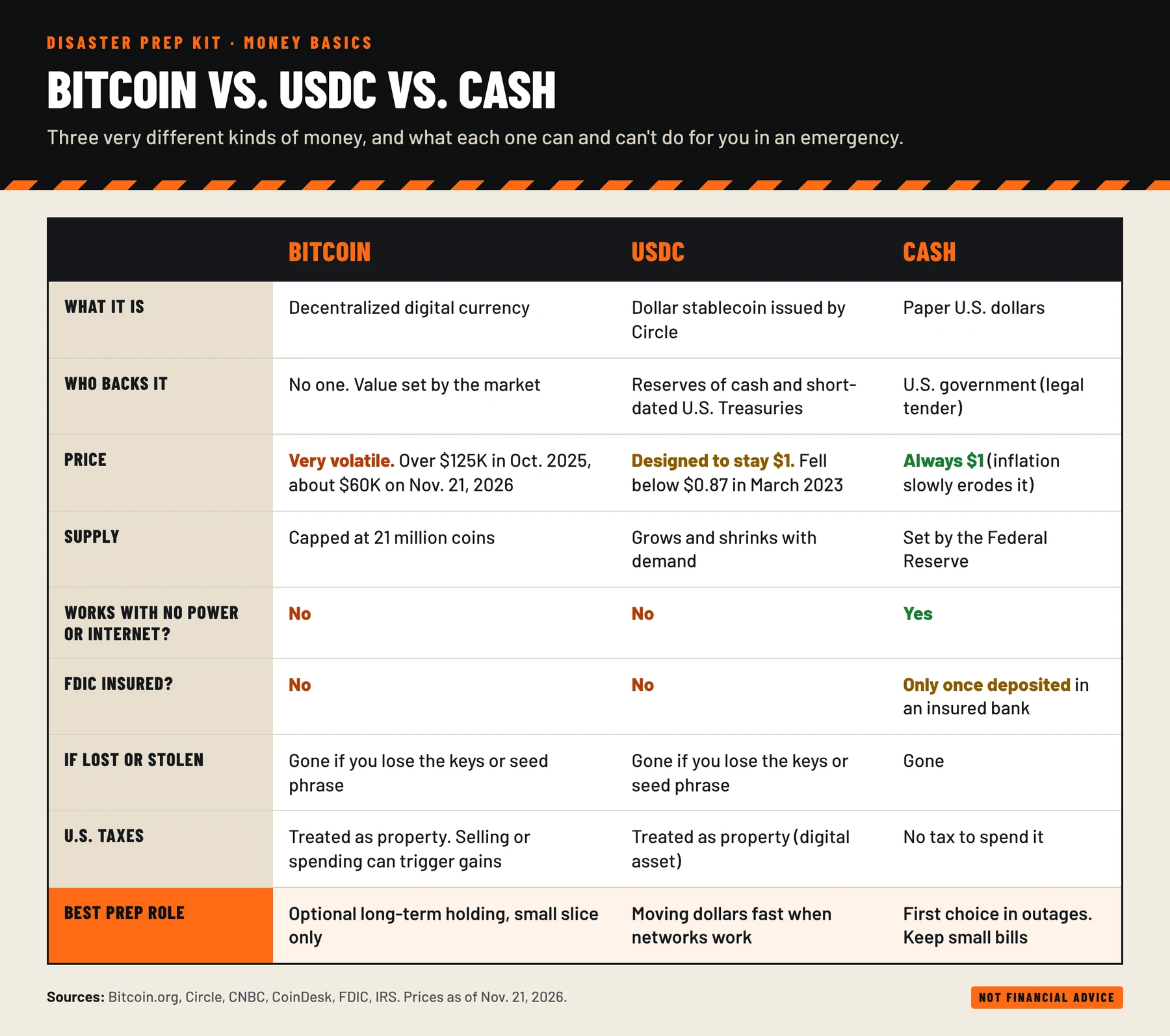
Bitcoin's price can move more in a day than a savings account earns in a year. It set a record above $125,000 in October 2025. On November 21, 2026, CoinDesk reported it had fallen as low as $55,130, its weakest level since September 2024, before bouncing back to about $60,000. That's a drop of more than half from the peak. CoinGlass data shows bitcoin down about 31% for 2026 as of that date. The CFTC warns that virtual currencies are not backed by any government or central bank and can see flash crashes and market manipulation. Only put in money you could afford to lose.
Scams and Phishing
Scammers love crypto because transfers are fast and usually can't be reversed. The FBI's 2025 Internet Crime Report logged 181,565 complaints involving cryptocurrency, with more than $11 billion in reported losses. The FBI's full report says crypto investment fraud alone cost Americans $7.2 billion. Common setups include "wrong number" texts, online romances that turn into investment tips, fake trading apps that show fake profits, and "recovery" services that promise to get your money back for a fee. Read our deep dive on pig butchering crypto scams and our guide to text message scams.
Losing Your Keys
If you lose your private key or seed phrase and your device breaks, your coins are gone for good. There's no reset. This is the flip side of controlling your own money.
Exchange Failures: The FTX Lesson
In November 2022, FTX, then one of the world's largest crypto exchanges, collapsed. Its founder, Sam Bankman-Fried, was later sentenced to 25 years in prison, and NPR reported that at least $8 billion in customer funds were believed to have been stolen. Customers who left their coins on the exchange couldn't get them out when it failed.
Even Stablecoins Can Wobble: USDC in March 2023
When Silicon Valley Bank failed in March 2023, about $3.3 billion of USDC's roughly $40 billion in reserves was stuck there. CNBC reported that USDC fell below 87 cents. After regulators said all SVB depositors would be made whole, Circle said the reserve was fully available and USDC returned to its peg. A Federal Reserve analysis found USDC recovered over about three days. "Stable" means designed to hold $1, not guaranteed to.
No FDIC Insurance
Crypto is not a bank deposit. The FDIC lists crypto assets among the financial products it does not insure, and its fact sheet on crypto companies says it "does not insure assets issued by non-bank entities, such as crypto companies." That includes USDC and any crypto held at an exchange.
Taxes
The IRS says that for U.S. tax purposes, digital assets are considered property, not currency. Selling, trading, or spending crypto can trigger a capital gain or loss, and you must answer a digital assets question on your federal tax return. Keep records of what you paid and when.
Crypto Needs Power and the Internet
This is the big one for preparedness. To send bitcoin or USDC, you need a charged device and a working network connection, and the person you're paying needs them too. In a grid-down emergency, a storm, or a regional internet outage, crypto may be impossible to spend. And few local stores, gas stations, or pharmacies accept it in the first place. Crypto does not replace cash in small bills. At most, it's one more option alongside it.
Where Crypto Fits in a Preparedness Plan
If you decide crypto belongs in your plan, keep it in proportion:
- Cash first. Keep a reserve of small bills at home for outages, as we cover in our banking outage guide.
- Basics before speculation. Water, food, medicine, and an emergency fund in an insured bank or credit union come before any crypto.
- Small slice only. If you buy, use money you won't need in an emergency.
- Paper backup. Store your seed phrase and wallet instructions with your other important documents in a fireproof, waterproof place.
- Keep devices charged. A solar power bank and a hand-crank radio keep your phone and your news source working when the grid doesn't.
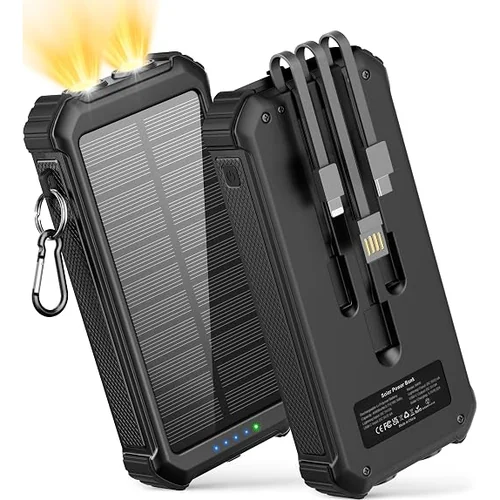
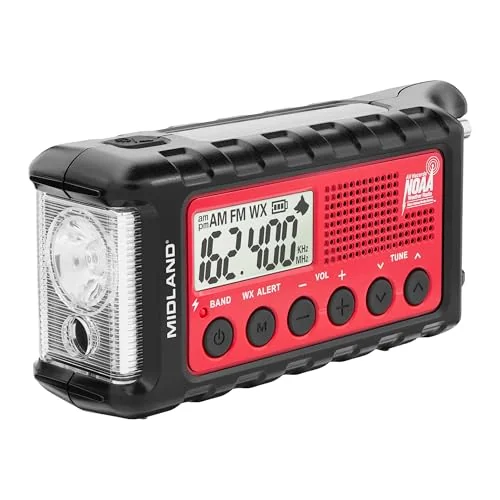
For more on staying connected and protected online, see our cyber disaster emergency kit and our guide to preparing for a grid-down scenario.
Frequently Asked Questions About Bitcoin and USDC
What is the difference between Bitcoin and USDC?
Bitcoin is a decentralized digital currency with a fixed supply of 21 million coins and a price that rises and falls with the market. USDC is a stablecoin issued by Circle that is designed to stay worth $1 and is backed by cash and short-dated U.S. Treasuries held in reserve.
Is USDC as safe as money in the bank?
No. USDC is not a bank deposit and is not FDIC insured. It is backed by reserves that Circle reports on publicly, and the GENIUS Act will add federal rules starting January 18, 2027, but USDC briefly fell below 87 cents in March 2023 when part of its reserves was stuck at Silicon Valley Bank.
Can I use Bitcoin or USDC if the power and internet go down?
Usually not. You need a working device and a network connection to send crypto, and so does the person you're paying. That's why preparedness experts keep cash in small bills for outages and treat crypto as an extra, not a replacement.
What happens if I lose my seed phrase?
If you lose both your wallet device and your seed phrase, your crypto is gone permanently. No company can reset it. Write your seed phrase on paper or steel and store it somewhere secure and fireproof.
Do I have to pay taxes on crypto?
Yes. The IRS treats digital assets as property. Selling, trading, or spending crypto can create a taxable gain or a deductible loss, and you must answer the digital assets question on your federal tax return.
Should I invest in Bitcoin for emergencies?
Bitcoin is too volatile to be an emergency fund. Its price fell by more than half from its October 2025 record to November 2026. If you choose to hold some, keep it small, keep your emergency savings in cash and insured accounts, and get advice from a licensed professional.
Sources
- Satoshi Nakamoto, Bitcoin: A Peer-to-Peer Electronic Cash System (2008)
- Bitcoin.org, Frequently Asked Questions
- CNBC, Bitcoin network completes fourth-ever 'halving' of rewards to miners (April 19, 2024)
- CNBC, Bitcoin hits new record above $125,000 (Oct. 6, 2025)
- CoinDesk, Bitcoin bounces 9% from two-year low to retake $60,000 (Nov. 21, 2026)
- CoinGlass, Bitcoin Price in 2026
- Circle, USDC
- Circle, Transparency & Stability
- Circle, $3.3 Billion of USDC Reserve Risk Removed, Dollar De-peg Closes (March 13, 2023)
- CNBC, Stablecoin USDC breaks dollar peg after firm reveals it has $3.3 billion in SVB exposure (March 11, 2023)
- Federal Reserve, Primary and Secondary Markets for Stablecoins (Feb. 23, 2024)
- The White House, Fact Sheet: President Donald J. Trump Signs GENIUS Act into Law (July 18, 2025)
- OCC, Bulletin 2026-50: GENIUS Act Regulations Final Rule (Oct. 21, 2026)
- U.S. Treasury, Treasury Seeks Public Comment on GENIUS Act Proposed Rulemaking (Aug. 17, 2026)
- SEC (Investor.gov), Crypto Asset Custody Basics for Retail Investors (Dec. 12, 2025)
- CFTC, Customer Advisory: Understand the Risks of Virtual Currency Trading
- FBI, Cryptocurrency and AI Scams Bilk Americans of Billions (April 6, 2026)
- FBI IC3, 2025 Internet Crime Report (PDF)
- NPR, Sam Bankman-Fried sentenced to 25 years for his FTX crimes (March 28, 2024)
- FDIC, Financial Products That Are Not Insured by the FDIC
- FDIC, Fact Sheet: What the Public Needs to Know About FDIC Deposit Insurance and Crypto Companies
- IRS, Digital Assets